
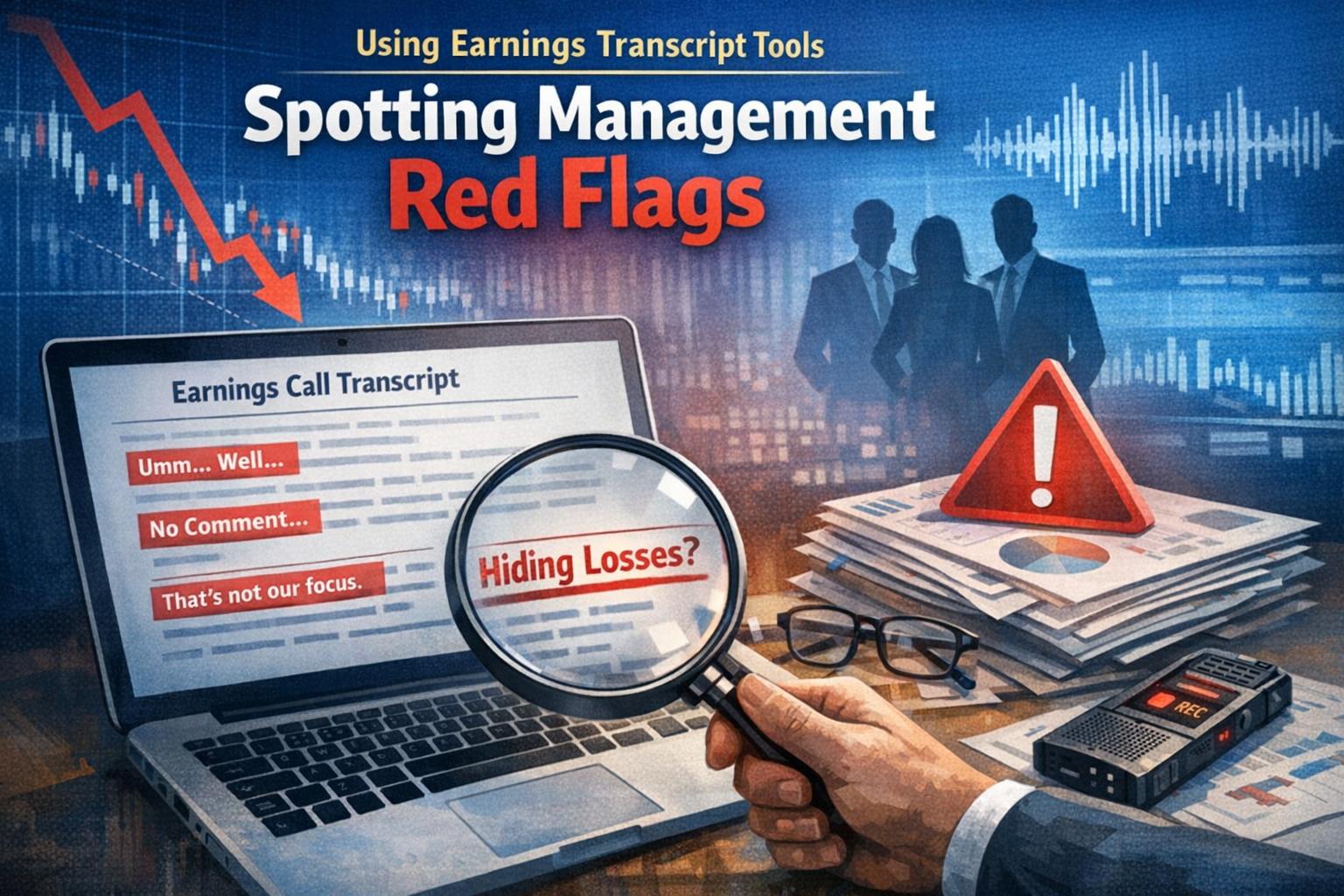
Quarterly earnings calls provide direct access to management’s perspective on company performance, strategy, and risk. While financial statements present structured and standardized data, transcripts capture tone, language patterns, emphasis, and unscripted responses. Investors who systematically review these transcripts can identify early warning signs that may not yet appear in reported numbers. Modern earnings transcript tools enhance this process by enabling faster search, structured comparison, keyword tracking, and sentiment analysis across reporting periods. By integrating transcript review into a broader analytical framework, investors can strengthen their ability to evaluate management credibility and detect emerging operational or financial stress.
Why Earnings Transcripts Matter
Earnings calls generally consist of two components: prepared remarks from senior executives and a question-and-answer session with analysts. The prepared remarks often reflect carefully structured messaging, crafted with investor relations teams and reviewed by legal counsel. These statements provide insight into how management wishes to frame company performance, strategic priorities, and market conditions. The Q&A session, in contrast, introduces a less structured dynamic. Analysts may challenge assumptions, request clarification on weak segments, or inquire about forward-looking risks. The exchange creates opportunities for inconsistencies, hesitation, or elaboration that are not evident in financial tables.
While financial results are bound by accounting standards, executive language is not standardized. Subtle shifts in phrasing, increased reliance on conditional qualifiers, or recurring references to external headwinds can reveal underlying operational pressures. Because transcripts preserve this language verbatim, they allow retrospective analysis. Investors can return to prior quarters and assess whether management commentary was consistent, overly optimistic, or later contradicted by events. This historical record transforms transcripts into a comparative tool rather than a one-time information source.
Transcripts also convey emphasis. The amount of time dedicated to certain business segments, geographic markets, or expense categories may signal internal priorities or concerns. An executive who devotes lengthy commentary to supply chain resilience, for example, may be anticipating disruption even if current financial metrics appear stable. Over time, changes in focus can indicate shifting strategic direction before such changes materially affect reported results.
Structural Differences Between Prepared Remarks and Q&A
The prepared section of an earnings call typically outlines headline results, summarizes major operational developments, and reiterates long-term objectives. Because it is scripted, deviations in content or structure across quarters may be particularly meaningful. For instance, the consistent presentation of key performance indicators in a predictable order reflects stability. If that order or emphasis changes without explanation, it may signal evolving pressures within the business.
The Q&A portion provides a more dynamic source of information. Analysts often focus on areas where financial statements lack granularity, such as customer concentration, backlog trends, contract renewals, or regulatory exposure. The precision with which executives answer these questions can reveal internal clarity or uncertainty. Direct, data-supported responses suggest operational visibility, while abstract or generalized answers may imply limited forecasting confidence.
Careful reading of exchanges can also reveal how management handles follow-up questions. When analysts request clarification and executives respond with additional specificity, it demonstrates transparency. Conversely, repeated reframing of the original question or substitution of different metrics can indicate reluctance to address specific concerns. Over multiple quarters, these behavioral patterns become easier to evaluate.
Using Transcript Tools for Pattern Recognition
Manual review of several years of transcripts for a single company can require substantial time. For investors covering multiple securities, the volume of material becomes impractical to analyze without technological assistance. Transcript platforms and institutional research systems allow users to search for keywords, filter exchanges by speaker, and compare historical periods side by side. These tools reduce friction in the research process and enable systematic pattern recognition.
Keyword search capabilities allow users to track strategic themes. For example, recurring references to “pricing pressure,” “inventory normalization,” or “customer optimization” can be quantified over time. If a term begins to appear more frequently, it may represent emerging operational concern. Conversely, terms associated with prior growth initiatives may gradually disappear from commentary, suggesting shifting priorities or diminished opportunity.
Some advanced systems incorporate natural language processing techniques to evaluate changes in tone or sentiment. While sentiment metrics should not be interpreted as definitive indicators, they can provide directional signals. An observable decline in positivity or an increase in uncertainty-related language may warrant closer review. Importantly, such insights are most useful when evaluated longitudinally rather than in isolation.
Side-by-side transcript comparison enhances context. Reviewing three or four quarters simultaneously can highlight subtle but persistent modifications in narrative framing. The ability to scroll through aligned sections of multiple calls reduces reliance on memory and exposes incremental changes that might otherwise go unnoticed.
Red Flag: Evasive or Overly Complex Answers
During Q&A sessions, analysts often pose direct inquiries regarding margins, cost structures, competitive positioning, regulatory investigations, or capital allocation decisions. A potential red flag arises when executives repeatedly offer indirect responses. Instead of providing numerical clarification, they may introduce tangential topics or highlight unrelated performance indicators.
Complex language can also function as deflection. Extended explanations that fail to address the core issue may obscure the absence of a clear answer. By isolating the transcript segments that correspond to specific analyst questions, investors can assess whether management consistently engages with the substance of inquiries. When multiple analysts seek clarification on the same topic across consecutive quarters and responses remain imprecise, the pattern becomes more significant.
In some cases, evasiveness reflects legitimate uncertainty. Highly volatile industries or evolving regulatory frameworks may limit management’s ability to provide definitive projections. However, consistent avoidance of measurable discussion—particularly when financial reporting later reveals deterioration—can indicate that management was aware of developing weakness before formally acknowledging it.
Red Flag: Sudden Changes in Key Performance Language
Language surrounding core business drivers often reflects management confidence. A company that consistently emphasizes “strong pricing power” or “durable demand elasticity” communicates stability in margins and revenue growth. If subsequent transcripts begin to reference a “competitive pricing environment” or “selective discounting strategies,” the rhetorical shift may correspond with internal pressures affecting profitability.
Because such differences are subtle, transcript analysis tools offer particular value. Measuring the frequency of previously emphasized growth terms can reveal gradual decline. If mentions of “expansion opportunities” or “pipeline visibility” decrease over several quarters, management may be moderating expectations before issuing formal downward revisions.
Investors should interpret linguistic changes within broader industry and macroeconomic context. External factors can necessitate honest recharacterization. However, when terminology softens while management maintains optimistic forward guidance, inconsistency emerges. Close attention to both wording and numeric projections improves analytical rigor.
Red Flag: Inconsistent Statements Across Periods
Credible management communication is generally consistent unless material business conditions change. If executives describe a specific market as “stable and predictable” in one quarter and later refer to it as “rapidly shifting” without identifying catalysts, the discrepancy warrants examination. Reviewing prior transcripts clarifies whether commentary evolved gradually or abruptly.
Inconsistent statements may relate to customer concentration, regulatory exposure, technological disruption, or supply chain conditions. Investors can align transcript commentary with formal filings and operational data. When divergence appears between spoken assurances and subsequent risk disclosures, questions arise about internal forecasting accuracy.
Transcript comparison tools allow rapid verification of such discrepancies. Rather than relying on recollection of prior messaging, investors can consult archived statements verbatim. This reduces interpretive bias and supports objective evaluation of management reliability.
Red Flag: Reduced Transparency on Guidance
Forward guidance reflects management’s expectations for revenue, earnings, capital expenditures, and strategic milestones. During periods of macroeconomic uncertainty, some reduction in precision may be reasonable. However, notable shifts from detailed quantitative targets to generalized strategic commentary may indicate declining visibility.
Transcript review can reveal how executives discuss future performance. A transition from stating specific percentage growth targets to referencing “long-term opportunities” without measurable benchmarks limits assessable accountability. The relative balance between quantitative guidance and qualitative optimism becomes informative.
Withdrawal of formal guidance may stem from genuine unpredictability, but repeated reduction in disclosure breadth can impede investor evaluation. Analysts tend to probe these changes during Q&A sessions. The quality and specificity of responses help investors determine whether reduced transparency reflects temporary uncertainty or deeper operational instability.
Red Flag: Defensive Tone Toward Analysts
Although tone analysis contains inherent subjectivity, observable defensiveness during analyst questioning can indicate internal stress. Executives who dismiss concerns without supporting evidence or attribute weak performance exclusively to uncontrollable external factors may be minimizing accountability. By contrast, balanced acknowledgment of challenges accompanied by operational detail suggests measured control.
Sentiment analysis tools embedded in some transcript platforms quantify linguistic patterns associated with uncertainty, negation, or emphasis. These metrics should not replace qualitative reading, but they provide comparative benchmarks across time and industry peers. When an individual company exhibits a marked shift toward guarded language relative to its own historical baseline, further investigation may be warranted.
Investors should consider whether multiple analysts raise similar issues. Converging lines of questioning often reflect shared industry observations. If executives respond with generalized reassurances rather than data-based clarification, the underlying issue may persist beyond the call.
Integrating Transcript Insights with Financial Analysis
Transcript insights are most effective when integrated with traditional financial review. Revenue growth, margin trends, free cash flow stability, leverage ratios, and working capital metrics provide quantitative grounding. When language and numbers align, management credibility is reinforced. When divergence appears, additional due diligence becomes appropriate.
For example, if executives emphasize disciplined cost control while operating margins decline, investors should examine expense composition in greater detail. Similarly, repeated references to robust demand should be supported by order backlog expansion or improved conversion rates. Inconsistencies between narrative and data often precede formal earnings revisions.
Transcripts can also inform scenario analysis. Management discussion of industry risks, geopolitical exposure, or supply constraints helps shape sensitivity assumptions within valuation models. Statements concerning capital allocation priorities provide insight into future share repurchases, debt reduction, or acquisition strategy.
Institutional investors may incorporate structured transcript analysis into internal research frameworks. By cataloging language changes across portfolio companies, analysts can detect sector-wide shifts. Retail investors, while operating with fewer resources, can still benefit from disciplined review of available transcripts and use of search tools to focus on recurring themes.
Developing a Systematic Review Process
Consistency enhances the value of transcript analysis. Reviewing each quarterly call with similar criteria—such as examination of guidance specificity, evaluation of Q&A responsiveness, and comparison of strategic terminology—reduces selective interpretation. Maintaining written notes summarizing key statements allows future verification when conditions evolve.
A structured process may involve comparing current commentary with the same quarter in the prior year to account for seasonality. Additionally, aligning transcript observations with relevant industry data strengthens contextual understanding. By treating transcripts as longitudinal records rather than isolated communications, investors increase analytical depth.
Ultimately, earnings transcripts serve as qualitative complements to quantitative disclosures. They capture managerial orientation, risk framing, and strategic communication in real time. Modern transcript tools expand the accessibility and comparability of this information, enabling faster identification of patterns that might otherwise remain obscured.
Through disciplined analysis, investors can detect red flags such as evasiveness, linguistic softening around key metrics, reduced transparency, inconsistent statements, and defensive responses. While no single indicator guarantees deteriorating performance, recurring behaviors across consecutive quarters often precede measurable financial impact. Incorporating transcript review into a comprehensive research process supports more informed decision-making and enhances the evaluation of management credibility over time.