
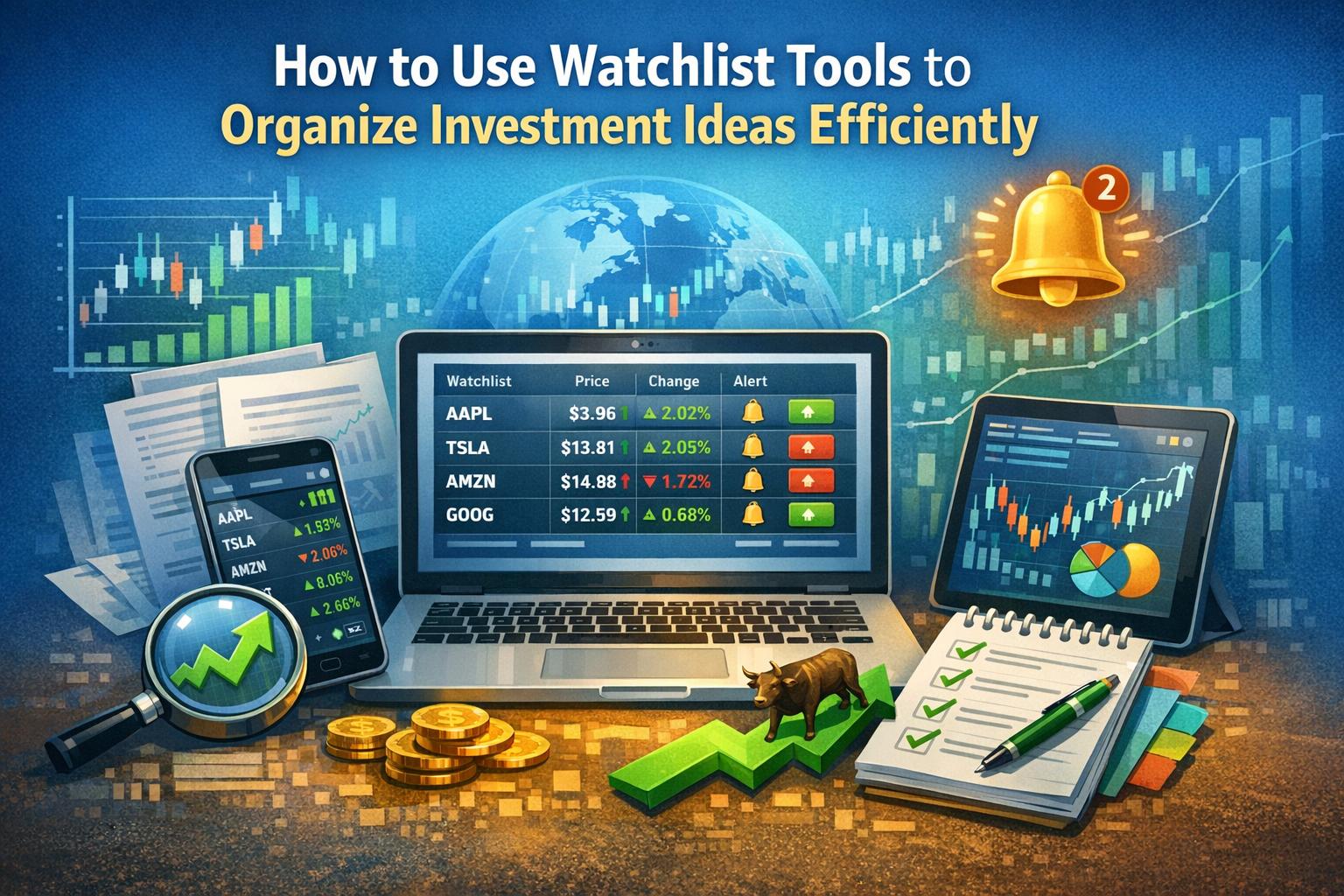
Watchlist tools help investors organize, monitor, and evaluate potential investments before committing capital. By structuring ideas in a centralized system, investors can compare performance, review fundamentals, and track market movements efficiently. A well-maintained watchlist supports disciplined decision-making and reduces impulsive trades. Rather than functioning as a simple list of ticker symbols, an effective watchlist operates as a dynamic research environment where data, analysis, and strategy intersect in a structured way.
Understanding the Purpose of a Watchlist
A watchlist is a curated collection of financial instruments such as stocks, exchange-traded funds (ETFs), bonds, commodities, or cryptocurrencies that an investor wishes to follow closely. Its primary function is to separate research candidates from active holdings while keeping relevant data accessible. This separation creates a structured workflow in which potential investments are observed, evaluated, and compared before capital is allocated.
Unlike a portfolio tracker, which measures the performance of assets already owned, a watchlist focuses on observation and preparation. It allows investors to define criteria in advance and wait for conditions that align with their objectives. Instead of reacting to daily market volatility, investors can concentrate on a defined group of assets that meet predetermined strategic requirements.
Most online brokerage platforms and financial research websites integrate watchlist features directly into their dashboards. Users can customize layouts, create multiple lists, and apply screening filters. Advanced platforms provide data synchronization across devices, ensuring consistent access to market information. By consolidating this information into a single interface, investors reduce the need to consult multiple sources during routine monitoring.
Structuring Watchlists by Strategy
Organizing a watchlist according to investment strategy improves clarity and analytical efficiency. Maintaining one extensive list of securities can create informational overload and reduce focus. Segmenting assets according to theme, objective, or timeframe enables more precise evaluation.
A common structural approach involves grouping securities by sector. Separate lists for technology, healthcare, industrials, energy, and consumer goods facilitate direct comparison within industries. Sector-based segmentation is particularly useful for monitoring macroeconomic trends, regulatory developments, or supply chain conditions that influence specific segments of the economy.
Another approach involves strategy-based segmentation. For example, a value-oriented investor may maintain a dedicated list of undervalued equities characterized by low price-to-earnings ratios and stable cash flows. A growth investor may track companies demonstrating consistent revenue expansion or innovation-driven market share gains. Likewise, investors focused on income generation might isolate dividend-paying securities with established distribution histories.
Event-driven watchlists represent an additional layer of organization. These lists may include companies approaching earnings announcements, firms undergoing mergers or acquisitions, or securities influenced by anticipated policy decisions. Structuring assets around identifiable catalysts allows investors to monitor developments within defined time horizons.
Timeframe segmentation also enhances flexibility. Long-term investors may keep a separate list for strategic holdings under extended evaluation, while traders may maintain shorter-term lists tailored to technical patterns or volatility characteristics. This division prevents overlap between fundamentally driven ideas and short-term tactical opportunities.
Using Key Metrics for Efficient Monitoring
An effective watchlist extends beyond tracking current price levels. Customizing displayed data fields enables a multidimensional view of potential investments. Most platforms allow the addition of valuation ratios, dividend metrics, technical indicators, trading volume, and performance comparisons across different periods.
Commonly monitored metrics include the price-to-earnings ratio, price-to-book ratio, market capitalization, and earnings per share. These figures provide insight into valuation and financial stability. For income-focused investors, dividend yield, payout ratio, and dividend growth rate are central indicators. Monitoring these metrics directly from the watchlist interface eliminates the need for repeated navigation to separate research pages.
Performance-based data points such as one-day, one-month, year-to-date, and multi-year percentage changes support comparative analysis. These measures help investors determine whether a security’s recent movements align with broader market trends or deviate significantly from peer performance.
Volume and volatility statistics can signal increased trading activity or heightened uncertainty. A surge in trading volume, for instance, may reflect institutional participation or reaction to new information. Including such indicators on a watchlist supports timely recognition of changing market conditions.
Customization also permits prioritization. Investors can arrange columns to highlight the most relevant variables for their strategy. Sorting functions allow quick identification of securities meeting specific thresholds, such as those approaching target valuation levels or displaying accelerated earnings momentum.
Incorporating Fundamental and Technical Analysis
Watchlists can accommodate both fundamental and technical analytical approaches. Investors who emphasize company fundamentals may use the watchlist to monitor revenue trends, profit margins, debt ratios, and analyst estimates. These indicators help determine whether a company continues to meet the criteria that justified its initial inclusion.
Technical-oriented investors may configure watchlists to display moving averages, relative strength index readings, or breakout levels. Observing these indicators across multiple securities allows efficient identification of patterns such as consolidation ranges or momentum shifts.
Combining fundamental and technical perspectives within a single watchlist framework creates a balanced analytical process. For example, an investor might identify fundamentally strong companies and then wait for technical confirmation before executing trades. The watchlist acts as the coordination point between these two analytical domains.
Setting Alerts and Notifications
Price alerts serve as a central component of systematic watchlist management. By defining entry or review thresholds in advance, investors reduce the need for constant market surveillance. Notifications can be configured for specific price levels, percentage movements, or technical indicator triggers.
Alerts tied to earnings release dates or dividend declarations support fundamental monitoring. Being informed of scheduled corporate events ensures timely review of financial results and management guidance. This structured approach reduces reliance on reactive news consumption.
Some platforms permit conditional alerts, such as triggering a notification when a valuation metric falls below a defined level. These features enhance automation and reinforce rule-based decision-making. Automated reminders also support time management by allowing investors to allocate attention efficiently across multiple assets.
Maintaining and Updating the Watchlist
A watchlist requires active maintenance to remain relevant. Market dynamics, corporate developments, and macroeconomic changes may alter the suitability of previously identified opportunities. Periodic review ensures that the list reflects current investment priorities.
Quarterly earnings seasons provide structured opportunities for reassessment. Companies that consistently fail to meet financial expectations may require removal from the list, while emerging firms demonstrating improving fundamentals may warrant addition. This ongoing process keeps the watchlist aligned with objective performance criteria.
Documenting the rationale for each addition strengthens analytical discipline. Many platforms allow users to attach notes to individual securities. Recording the initial investment thesis, valuation targets, and anticipated catalysts establishes a reference point for future evaluation. Comparing stated expectations with actual outcomes enhances long-term decision quality.
Removing outdated or redundant entries prevents clutter and preserves focus. An extensive list with inactive or irrelevant securities may dilute attention and complicate monitoring efforts. Periodic refinement maintains clarity.
Integrating Watchlists with Portfolio Management
Watchlists function most effectively when integrated with portfolio tracking systems. Investors can compare the risk characteristics of potential additions with existing holdings, assessing factors such as sector concentration, geographic exposure, and market capitalization distribution.
Evaluating correlation between watchlist candidates and portfolio assets supports diversification decisions. For example, adding a company highly correlated with existing holdings may increase concentration risk without providing incremental diversification benefits. Review through integrated tools allows informed allocation choices.
Some brokerage platforms simulate hypothetical portfolio additions using watchlist data. Investors may assess how incorporating a particular security would affect overall returns or volatility. These simulations provide quantitative context before executing transactions.
Maintaining a clear distinction between ideas under evaluation and active investments fosters a systematic workflow. The watchlist serves as a research pipeline where ideas mature before potential inclusion in the portfolio.
Supporting Long-Term Investment Discipline
Consistent use of watchlists contributes to structured investment habits. Investors who document criteria, monitor key metrics, and wait for predefined conditions are less likely to engage in unplanned trades. The process encourages deliberate evaluation rather than rapid reaction.
Watchlists also facilitate historical learning. Reviewing archived entries reveals patterns in decision-making, including instances where securities were removed prematurely or retained despite deteriorating fundamentals. Such retrospective analysis supports refinement of selection criteria.
For long-term investors, the watchlist becomes an extension of strategic planning. It reflects thematic interests, sector outlooks, and evolving market perspectives. Observing how securities behave across economic cycles deepens understanding of risk and resilience.
Adapting Watchlists to Different Market Conditions
Market environments shift over time, influencing the relevance of specific sectors or strategies. During periods of expansion, growth-oriented lists may contain numerous candidates meeting performance thresholds. In contrast, more defensive sectors may become prominent during economic slowdowns.
Adjusting watchlist composition in response to macroeconomic indicators, interest rate trends, or inflation data ensures alignment with prevailing conditions. For example, rising interest rates may impact valuation-sensitive sectors differently than stable rate environments. Monitoring these factors within designated watchlists provides structured insight into sector rotation.
Maintaining flexibility while adhering to strategic principles allows the watchlist to evolve without losing coherence. Structured adaptation prevents abrupt shifts driven by short-term volatility.
Using Watchlists for Comparative Analysis
One of the principal advantages of a well-organized watchlist is the ability to conduct side-by-side comparisons. Displaying multiple securities from the same industry enables evaluation of relative valuation, growth rates, and balance sheet strength. Comparative analysis supports identification of outliers that may warrant deeper investigation.
Benchmark comparisons add further context. Investors may track indices alongside individual securities to measure relative performance. Observing whether a stock consistently outperforms or underperforms its benchmark informs assessments of management effectiveness and competitive positioning.
Comparative evaluation can also extend to international markets. Maintaining separate regional watchlists allows observation of economic trends across geographies, facilitating global diversification decisions.
Conclusion
Using watchlist tools effectively requires deliberate organization, consistent monitoring, and regular reassessment. By segmenting assets according to strategy, customizing relevant data fields, integrating alerts, and documenting analytical rationale, investors convert a simple tracking feature into a structured research framework.
A disciplined watchlist promotes clarity between potential opportunities and active holdings, supports comparative evaluation, and enhances portfolio integration. Over time, this systematic approach strengthens analytical consistency and contributes to informed investment decisions grounded in predefined criteria rather than short-term market movements.